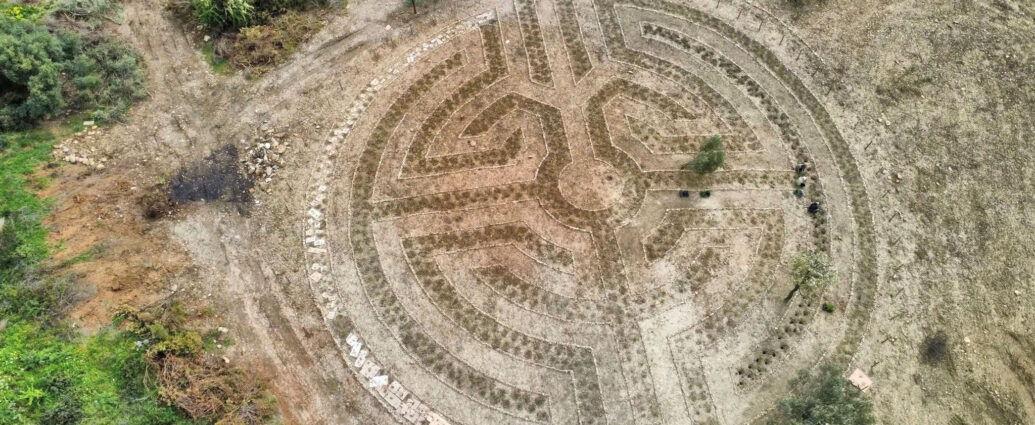
Tracing the Origins of the Name Roseto
September 2024. I first come across the name Roseto Capo Spulico online. Initial contact is established, and the first exchanges of correspondence begin. Coming from a background in communications, I immediately start researching the origins of the name Roseto—where it comes from, what it means, and what historical, cultural, and symbolic layers lie behind it.
For the time being, I pay little attention to the “Capo Spulico” part of the name. Almost instinctively, my focus settles on “Roseto,” despite knowing virtually nothing about the town or the history of the surrounding region. This is undoubtedly influenced by the fact that, within the context of European languages, it is easy to assume—even without extensive research—that the name Roseto is somehow connected to roses. It therefore seems like familiar ground, a subject that should be relatively straightforward to explore.
With a little more research, it quickly becomes clear that the town’s name is derived from the Latin word rosetum. In this term, rosa means “rose,” while the suffix -etum was used in Old and Classical Latin as a place-name ending denoting an area planted with or covered by a particular type of vegetation.
Consider the word arboretum. Here, arbor means “tree,” while -etum denotes a place planted with or devoted to a particular type of vegetation. The original, literal meaning of arboretum is therefore a collection of trees, or a garden and landscape intentionally planted with trees. It does not simply refer to a park, but rather to a deliberately established and often systematically organized tree collection, frequently created for scientific or botanical purposes. In the same way, olivetum refers to an olive grove, quercetum to an oak grove, and pinetum to a collection or grove of coniferous trees.
Accordingly, rosetum literally means a rose garden or a landscape planted with roses.
From a linguistic perspective, the name is therefore a form of toponymy that refers to the actual presence of vegetation. In the case of Roseto, it is reasonable to assume that roses were once a significant and distinctive feature of the area, closely tied to its identity.
This interpretation is further supported by the nature of place names themselves. Toponyms tend to preserve those features of a landscape that were considered distinctive, defining, or culturally significant at the time a place was named. When a settlement bears the name of a specific plant, as in the case of Roseto, it is in itself a strong indication that the plant had a noticeable, meaningful, or characteristic presence in the area when the name originated. Of course, this alone does not prove large-scale cultivation of roses, as suggested by the Sybarite legends, but it does suggest that the rose became an identity-forming element in the life of the community.
Further research confirms that the name Roseto is not a modern invention. It already appears in medieval documentary sources from the 12th century onward, and its use is attested in Norman–Swabian records. The town’s full official name, which remains in use today, was formally established in 1970 by presidential decree (D.P.R. 22 January 1970, No. 52), when the geographical designation “Capo Spulico” became an official and integral part of the municipality’s name.
The survival of the name for more than eight centuries suggests that the rose—whether as an actual garden, an estate name, or a symbolic and aesthetic marker—may have played a significant role in shaping the identity of the place. To this day, local tradition preserves the belief that the surrounding area was once covered with roses.
It was at this point that a question began to emerge: how might this name, and the centuries-old heritage it carries, be brought back to life and infused with new meaning today?
For me, the answer came in the form of a labyrinth.
As a creative practitioner, permaculture designer, and labyrinth designer and builder, the idea of a rose labyrinth immediately began to take shape in my mind. Through it, I saw a way to reconnect Roseto with this aspect of its identity and, at the same time, share that story with the wider world.
For me, linking the name of Roseto Capo Spulico to a rose labyrinth was not merely an aesthetic choice. My intention is to give contemporary, living expression to both the historical depth of the name and the rose tradition that continues to live on in the community’s collective memory.
This labyrinth is also a Reconciliation Labyrinth. The Reconciliation Labyrinth is the intellectual creation of South African labyrinth designer Claire Wilson. The name, the concept, the underlying geometry and design logic, as well as the archetypal pathway, are all part of her work. Building this labyrinth therefore required her permission, which she kindly granted and provided to me in writing.
The adaptive site design, scaling, on-site layout and staking, development of the proportional system, determination of path and planting-bed widths, optimization of the number of rose bushes, adaptation to the site’s natural conditions, integration of existing trees, on-site adjustments, and geometric recalculations were carried out jointly by my partner, Laura, and me.
The physical construction was carried out collaboratively with members of the Tesoro di Roseto Cooperativa di Comunità, as well as volunteers and team members from Antiche Essenze di Calabria.
Diameter: 40 m (131.23 ft)
Path width: 1.65 m (5.41 ft)
Rose bed width: 1.65 m (5.41 ft)
Total walking path length: 351 m (1,151.57 ft)
Number of rose plants: 1,122
Two entrances facing east
One exit located between the entrances
Approximately 1.5 years from concept to completion
Approximately 1.5 months of physical construction
For more photos and videos, please visit our Facebook and Instagram pages and follow us there.
Your support helps us continue our work and bring new labyrinth projects to life.
Facebook:
https://www.facebook.com/studiosensodivita
Instagram:
https://www.instagram.com/studiosensodivita/
Thank you for your support!
Comments are closed, but trackbacks and pingbacks are open.